English
 Français
 Español

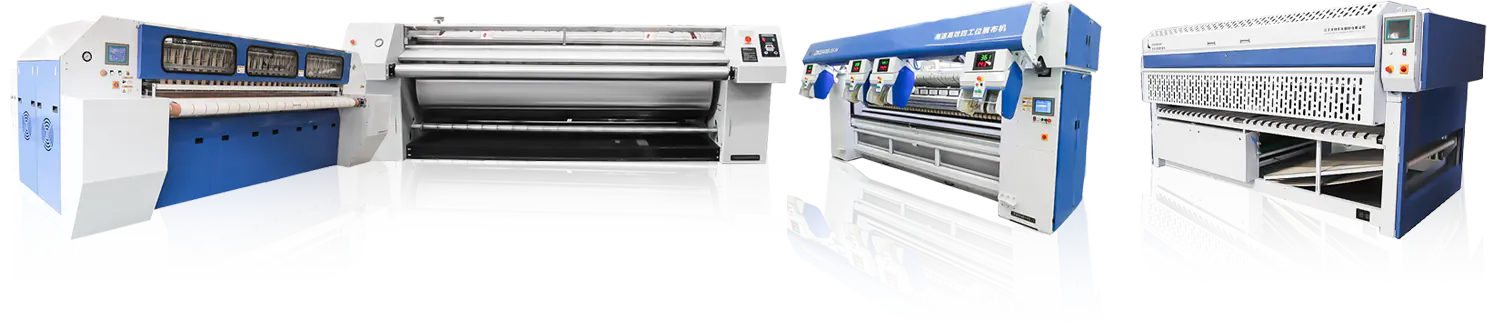







Energy efficiency in a cloth dryer is a function of heater modulation, not just insulation. A machine that modulates its burner or heating element in steps will waste less heat than one that runs full-on and cycles.

Industry News
Home / News / Industry News / How a Cloth Dryer Works: Heat, Airflow, Tumbling, and Moisture Control Explained

How a Cloth Dryer Works: Heat, Airflow, Tumbling, and Moisture Control Explained
Content
- 1 How a Cloth Dryer Works: The Three-Legged Principle
- 2 Inside the Drum: Airflow, Heat, and Tumbling
- 3 Gas, Electric, or Steam: Cloth Dryer Heat Sources Compared
- 4 How Sensor Controls Decide When a Load Is Dry
- 5 What Breaks First in a Cloth Dryer?
- 6 How to Choose a Cloth Dryer for Commercial Laundry
- 7 Frequently Asked Questions
PREV:Industrial Laundry Equipment for Hotels: A Practical Buyer's Guide to Capacity and CostNEXT:Laundry Presses: Extraction and Finishing Equipment for High-Volume Operations
OUR RELATED PRODUCTS
A 25 kg load of bath towels leaves a commercial washer at roughly 50 percent moisture by weight. That means 12.5 kg of water has to leave the fabric and travel through the exhaust duct within 40 minutes. A cloth dryer that handles this job cannot simply make things hot. It has to manage heat, mechanical motion, and air movement in a carefully balanced process. When one of those three elements drifts out of spec, the cycle time doubles, the energy bill climbs, and the linen starts to smell sour because the load dries from the outside in instead of evenly through the whole batch. This article explains how a cloth dryer works, and it covers the failure points that matter most to a commercial laundry operator.
How a Cloth Dryer Works: The Three-Legged Principle
Every cloth dryer, from a compact residential unit to a heavy-duty industrial tumble dryer, works by combining three inputs: heat, tumbling, and forced airflow. Remove any one of them, and the drying cycle doubles in length or stops completely.
Core definition: A cloth dryer is an air-handling machine that raises fabric temperature, rotates the load to expose new surface area, and moves saturated air out of the drum before it can recondense.
The drying curve is not linear. In an average cotton cycle, the first five minutes do very little drying while the drum and air reach operating temperature. The middle phase removes the majority of the free water. The final phase is the slowest because bound moisture inside the fibers has to migrate to the surface. For an operator, the important takeaway is that the machine is balancing two physical limits at once: the rate at which the heater can supply energy, and the rate at which the fan can carry water away. Increasing the heater power alone does not help if the fan is the bottleneck.
Moisture removed per phase, 25 kg cotton load
Values based on typical cotton toweling with an initial moisture content of 50 percent.
The practical implication for an operator is this: a dryer that is losing airflow cannot compensate by turning up the heat. If the exhaust path is restricted, the extra heat simply raises the exit temperature, which costs energy without improving evaporation.
Inside the Drum: Airflow, Heat, and Tumbling
The fundamental answer is that four functional systems do all the work in a cloth dryer: the airflow circuit, the heat source, the drum drive, and the control package.
The Airflow Circuit
A fan draws cool room air in through an intake, passes it over the heat source, then pushes it through the rotating drum. The air carries moisture out through the lint filter and exhaust duct. In a commercial setting, the duct run from the dryer to the roof is often several meters long, so every elbow and transition adds resistance. A blocked lint screen is the single most common cause of long cycle times in commercial laundries, and it is also the cheapest problem to fix.
The Heat Source
The heater raises the incoming air to a set point, typically between 60 and 90 degrees Celsius for cotton goods. Electric dryers use resistance coils, gas dryers burn a flame in a combustion chamber, and steam dryers use a finned coil carrying hot water. The heat source determines how fast the dryer reaches operating temperature and how much it costs to run each cycle.
The Drum and Lifters
The drum rotates at a low speed, usually 25 to 50 rpm, while internal lifters scoop the load and drop it back down. This mechanical action pushes every fabric surface into the hot air stream. The drum speed has to match the load size. Underfilled drums let the air short-circuit through the middle, so the outer layers dry faster than the inner layers.
| System | Primary job | Common failure signal |
| Airflow circuit | Move hot air and exhaust vapor | Long cycle, hot exhaust, lint buildup |
| Heat source | Raise air temperature 60-90 C | Cool exhaust, heater trip, high energy bill |
| Drum drive | Tumble load at 25-50 rpm | Loud thumping, belt smell, load does not move |
| Control package | End cycle at the right moisture | Overdrying, underdrying, no auto stop |
If you hear the dryer cycling on and off before the load is dry, the most common cause is a blocked airflow path, not a faulty heater. The heater trips on its overheat thermostat and then resets when the air cools.
These four systems interact more than you might think. A drum that is slightly too fast does not just tumble the load better; it also throws the fabric against the lint screen and can push lint into the airflow path. That is why a well-designed dryer is tuned around the whole system, not just the power of the heater.
Gas, Electric, or Steam: Cloth Dryer Heat Sources Compared
The answer is straightforward: the heat source determines both the energy cost per kilogram of laundry and the recovery rate of the machine.
Gas fired
Fast heat-up, lower running cost, requires combustion exhaust and a gas supply line.
Electric
Simple installation, no flue, but the highest operating cost per kg in most markets.
Steam heated
Good for facilities with an existing boiler plant; slowest heat-up but steady temperature.
| Heat source | Typical air temp | Recovery time | Relative cost per kg |
| Gas | 75-90 C | 4-6 min | Low |
| Electric | 70-85 C | 3-5 min | High |
| Steam | 70-80 C | 6-9 min | Medium |
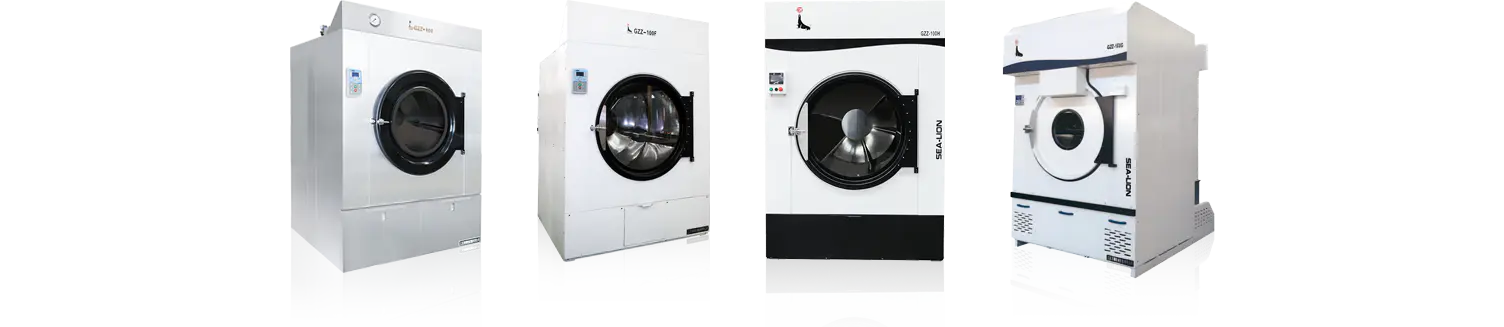
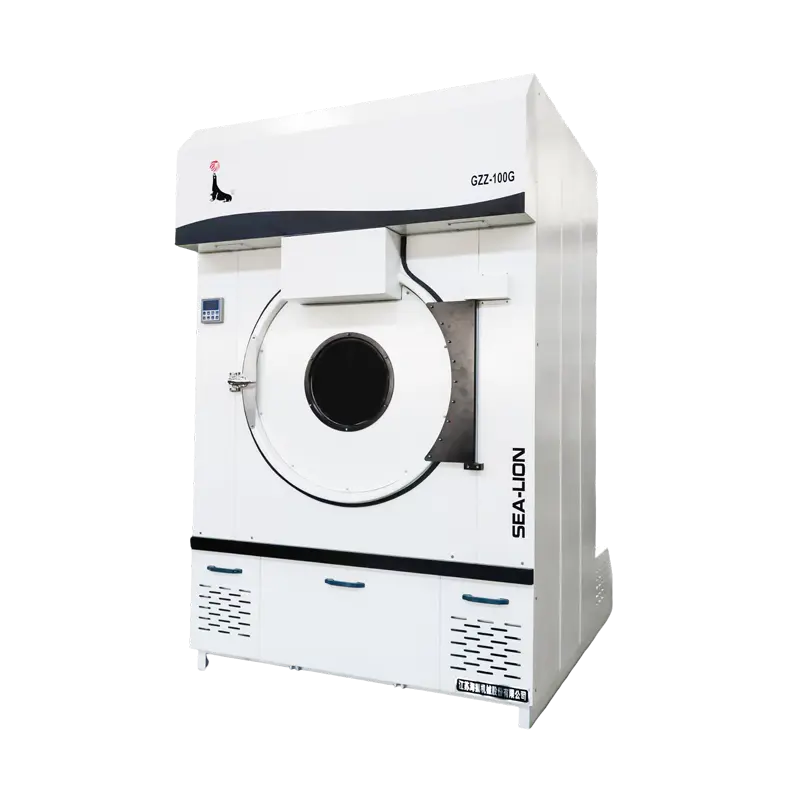
For a facility that runs two shifts, the gap between electric and gas can reach thousands of dollars per year. This is why the energy-saving industrial laundry dryer from Jiangsu Sea-Lion Machinery Co., Ltd. (Sea-Lion) is designed around more efficient heat transfer rather than a higher wattage rating. The burner on a well-tuned gas dryer brings the drum to target temperature in a fraction of the time that an equivalent electric coil needs, which means the machine can start removing water sooner in each cycle.
 Energy-Saving Industrial Laundry Dryer with Humidity SensingThis dryer uses efficient heat transfer and humidity sensing to reduce energy costs and end cycles only when fabrics are dry, making it ideal for high-volume operations with two shifts.View Product →
How Sensor Controls Decide When a Load Is Dry
A modern cloth dryer does not rely on a fixed timer. It uses a moisture sensing system that ends the cycle only when the exit air reaches a target humidity level.
The control package reads a thermistor in the exhaust stream or a conductivity probe that touches the fabric. When the air leaving the drum is no longer carrying a meaningful amount of water, the heater switches off and a cool-down phase begins. This protects textiles from overdrying and cuts energy waste.
- Thermostat control: simple, but overdries light items.
- Moisture sensing: matches cycle time to actual dryness.
- Microprocessor control: stores programs per fabric type and records diagnostics.
Overdrying is not just a comfort issue. It shortens fiber life, adds static, and increases the energy bill by as much as 15 percent because the dryer keeps firing after the water is already gone.
Sea-Lion's microprocessor controller tumble dryer is built around this logic, storing multiple drying programs so a single machine can handle towels, sheets, and uniforms without operator guesswork. A unit with saved programs also gives the laundry manager a way to lock in the cycle time for each account, which is important when the same machine is used for different clients.
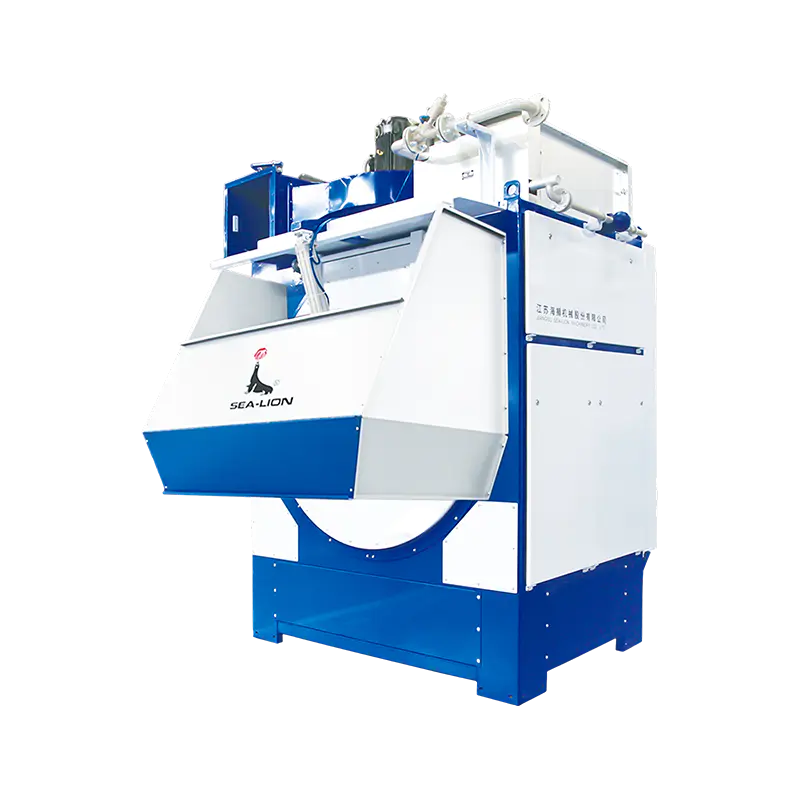 Microprocessor-Controlled Tumble Dryer with Multiple Drying ProgramsThis tumble dryer stores multiple drying programs, allowing operators to handle different fabric types without guesswork and lock in cycle times for consistent results across various laundry accounts.View Product →
What Breaks First in a Cloth Dryer?
In a commercial laundry environment, the first three failures are almost always airflow restriction, heater burnout, and drive belt wear.
- Lint buildup in the exhaust duct reduces airflow before any alarm sounds.
- An unrestricted heater fires continuously and eventually burns out on a hard load.
- A worn belt slips enough to reduce tumble speed without stopping the drum completely.
Rule of thumb: check the lint screen, then the exhaust duct, then the heater contacts. Do this weekly and you will prevent most cloth dryer downtime.
Preventive maintenance does not have to be complicated. A weekly check of the lint screen, a monthly cleaning of the exhaust duct, and a quarterly inspection of the belt tension will catch most problems before they turn into a full day of lost production. After an electrical fault, it is also worth checking the heater contactors, because a tripped overheat thermostat is often the only reason the dryer has stopped heating.
For a facility that runs dryers back to back, choosing a unit with an exterior lint access door and stainless steel airflow pipes is a practical way to make daily checks faster and safer.
How to Choose a Cloth Dryer for Commercial Laundry
The answer to the selection question is simple: size the machine by usable load weight and available drying time, not by drum volume alone.
25 kgLoad weight per cycle
40 minTarget cycle time
1.1 kWh/kgEnergy per kg of linen
2,000 m3/hRequired exhaust airflow
These four numbers tell you most of what you need to know before buying. If the airflow requirement cannot be met by the building duct system, the dryer will never hit its rated performance. This is the most common procurement mistake in laundry projects: a machine is chosen for its labeling, and the building engineer discovers later that the exhaust riser is too small.
Another factor is the turning radius of the drum. A heavy load needs a drum with strong lifters and a robust trunnion bearing. The bearing is the first structural component to fail when a dryer is consistently overloaded by 20 percent or more, because the drum weight at the front of the unit exceeds what the bearing was designed to handle.
For a step-by-step approach to sizing and heat source selection, see our guide on choosing the right industrial tumble dryer.
Sea-Lion's heavy-duty industrial tumble dryer is engineered for the 25 kg to 60 kg load range and includes the stainless steel drum, large lint door, and variable heat control that commercial operators need. It uses a reinforced drum shell and a shaft-mounted drive system to handle daily loading stress.
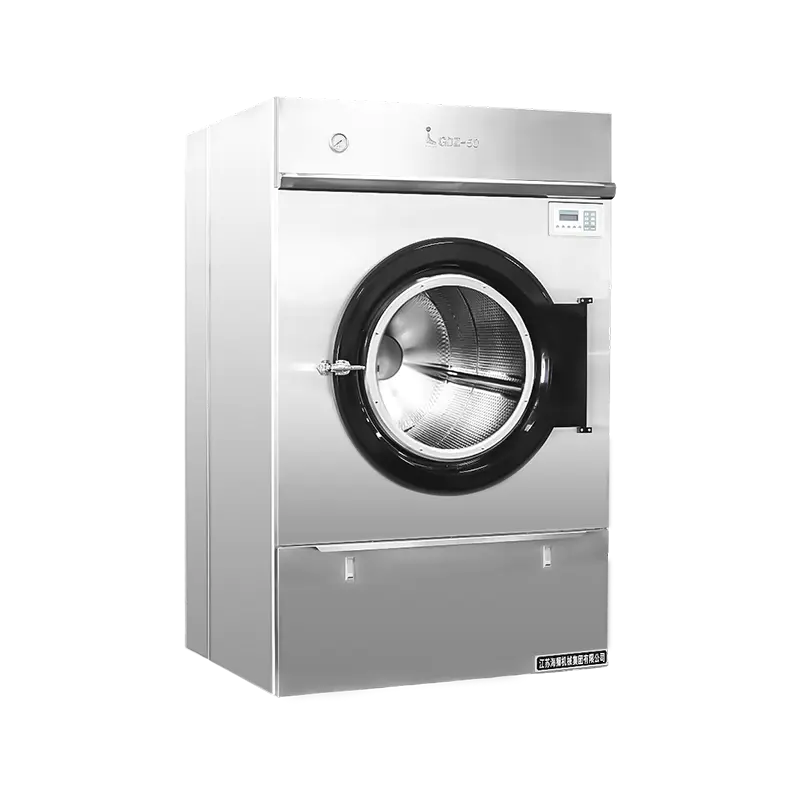 Heavy-Duty Industrial Tumble Dryer for 25–60 kg LoadsDesigned for robust daily use, this dryer features a reinforced drum, large lint door, variable heat control, and smart fan adjustments to accelerate drying while reducing steam consumption.View Product →
Frequently Asked Questions
Quick answers to the questions that come up most often when a cloth dryer is not performing as expected.
How long does a cloth dryer take to dry a 25 kg load?
A commercial cloth dryer with proper airflow and a 25 kg cotton load should reach a finished moisture content of about 3 to 5 percent in 35 to 45 minutes. Cycle time extends quickly if the lint screen is blocked or if the load is underfilled, because the drum tumbles fewer items and the hot air flows around them.
Why does a cloth dryer stop drying effectively?
The most common cause is restricted exhaust airflow from lint buildup. When air cannot leave the drum, the moisture does not leave either, and the dryer runs hotter without improving drying. Check the lint screen, the exhaust duct, and the fan blades in that order.
What is the difference between a vented and a ventless cloth dryer?
A vented dryer exhausts moist air out of the building. A ventless dryer uses a closed loop with a condenser to capture moisture. For commercial laundry operations with large loads, vented dryers are generally preferred because they have faster cycle times and lower energy costs.
Can a cloth dryer handle delicate fabrics?
It depends on the machine. A standard dryer can run low-temperature programs for synthetics, but delicate items such as silk or some activewear need a specially controlled cycle. Industrial dryers with programmable microprocessor control can store different temperature and tumble profiles for each fabric type.

- No. 2 Lehong Road, Leyu Town, Zhangjiagang, Suzhou City, Jiangsu Province, China
- +86-512-58602532
- [email protected]
Copyright @ Jiangsu Sea-Lion Machinery Co., Ltd. All rights reserved
Custom Laundry Equipment Suppliers